
Inspection & Monitoring →
Imported, calibrated instruments find what is actually wrong before anything is applied.

Breweries, distilleries, dairy-drink, and soft-drink plants need stainless steel that stays clean and free of biofilm. We inspect, clean, derouge, descale, polish, and passivate tanks, fermenters, and filling lines on-site, using safe citric acid based CitriSurf technology, aligned to USFDA, HACCP, GFSI, FSSAI, and BIS requirements.
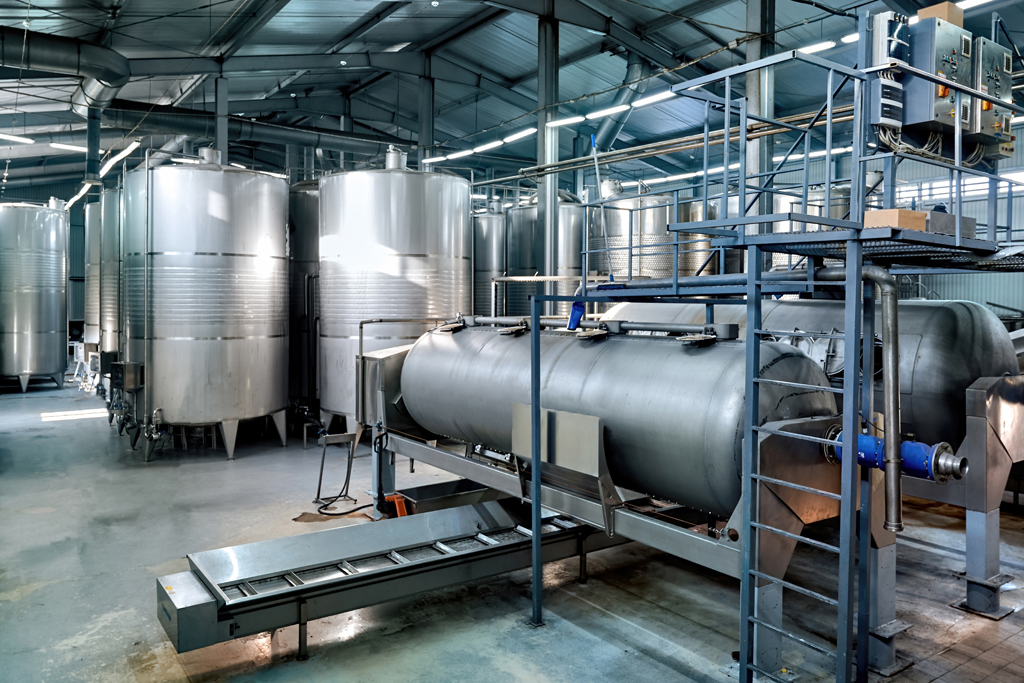
Beverage plants run wet, warm, and sugar-rich processes, which is exactly what biofilm and corrosion like. If stainless steel is not kept clean and well-passivated, deposits and rouge can build up in tanks, fermenters, and lines, affecting product taste, safety, and shelf life. Cleaning removes residue and biofilm, and passivation rebuilds the protective layer, so your equipment stays hygienic and corrosion-free.
Beverage processing carries real contamination risk, and food-safety standards keep getting stricter. Bacteria such as Listeria and E. coli are the kind of hazard a strong cleaning and sanitation program is built to prevent. If cleaning is treated as occasional rather than ongoing, product quality can suffer, which can lead to recalls. Clean, passivated stainless steel is a core part of keeping that risk down.
Some parts of a beverage plant are harder to keep clean than others, and those are where problems start:
We reach the inner and outer surfaces of this equipment, so cleaning and passivation are done properly, not just where it is easy to get to.
We handle the full surface treatment cycle for beverage equipment, on-site, with controlled temperature, flow, and pressure so the work is consistent across tanks, fermenters, and lines. We also advise on the right procedure to maintain each surface, so the fix holds.
Imported, calibrated instruments find what is actually wrong before anything is applied.
Remove residue, biofilm, and free iron from tanks and lines.
Remove rouge from tanks and hot process lines.
Remove scale, including after installation and on long-running systems.
On-site or at our premises, to repair and refinish the surface.
Smooth, low-roughness surfaces that give biofilm less to hold on to.
Rebuild the protective layer with citric acid based CitriSurf technology.
Documented, so your team can hold the surface between visits.
Every job ends with an inspection report and the documentation your auditor asks for.
Most beverage work happens where the equipment is. You pick whichever fits the job.
Tanks, fermenters, heat exchangers, and filling lines are treated in place, around your production and shutdown schedule.
Mechanical polishing and electropolishing can also be done at our premises when a part can be sent out, which suits valves, fittings, and smaller items.
Beverage plants answer to two sets of rules: food safety standards that govern the product and the plant, and equipment design standards that govern the machinery itself. Both come back to surface condition, because a surface that cannot be cleaned cannot be proven safe.
Standards are not a one-time certificate. They are a condition you have to hold between audits. Our work is built around all three stages.
We inspect the surface first, then clean, derouge, descale, polish, and passivate to bring it to a condition that stands up to a food safety audit.
New equipment: cleaning and passivation before a new tank or line goes live flush out installation debris, fabrication residue, and free iron.
Our imported, calibrated instruments check surface condition on a set frequency, so you see rouge or residue returning before it reaches the product.
Every visit: closes with an inspection report.
We hand over the procedure to hold the surface, with immediate remedies for what we found and frequency-based remedies for what is likely to come back.
Your records: your team keeps the documentation your auditor asks for.
Our passivation uses CitriSurf 77 Plus, a citric acid based, US-origin liquid with a pH of approximately 1.6. It is applied direct with no dilution, by spray, immersion, or wiping, and comes in 20 liter and 200 liter pails. It meets ASTM A967, ASTM A380, ASTM B600, and AMS 2700, and helps customers comply with NSF, USDA, USFDA, EU, cGMP, and global food and pharmaceutical requirements.
We passivate with citric acid based chemistry rather than nitric acid, so we remove free iron and build a protective layer without the fumes or hazards of nitric acid. This keeps beverage-contact surfaces safe while improving corrosion resistance, and it supports the hygiene records your team keeps for audits.
Rouging Solutions provides inspection and monitoring, cleaning, derouging, descaling, mechanical polishing, electropolishing, and passivation for beverage processing equipment across India, including brewery, distillery, dairy-drink, and soft-drink stainless steel. Beverage plants run wet, warm processes where biofilm and rouge build up in tanks, fermenters, heat exchangers, and filling lines, so regular cleaning and citric acid based passivation keep surfaces hygienic and corrosion-resistant. The work supports the benchmarks beverage plants are held to, including USFDA, HACCP, GFSI, FSSAI, and BIS in India, alongside the 3-A and EHEDG hygienic equipment design standards. Passivation uses CitriSurf 77 Plus, a citric acid based liquid that meets ASTM A967, ASTM A380, ASTM B600, and AMS 2700. Service is available on-call at the customer's site and at Rouging's own premises, and each job closes with an inspection report.
We are here to help! Request advice on your specific application or a quote on our products by filling in the form below.
Beverage processing is wet, warm, and often sugar-rich, which encourages biofilm and, over time, rouge on stainless steel. Regular cleaning and passivation keep surfaces clean and corrosion-free.
The food safety benchmarks are USFDA, HACCP, GFSI, FSSAI, and BIS (IS 6913) in India. On the equipment side, 3-A and EHEDG cover hygienic design. Our surface treatment work follows ASTM A967, ASTM A380, and AMS 2700.
HACCP is a food safety system that finds hazards in your process and sets control points against them. GFSI is a body that benchmarks food safety schemes so buyers recognize them. FSSAI is Indias food safety regulator.
Both are hygienic design standards for food and beverage equipment. They set expectations for surfaces that can be cleaned, and cleaning, polishing, and passivation are how a surface is brought to and held in that condition.
Yes. Mechanical polishing repairs and refinishes the surface, and electropolishing gives a smooth, low-roughness finish that is easier to clean. Both can be done on-site or at our premises.
Yes. We take on-call service at your plant, treating tanks, fermenters, heat exchangers, and filling lines in place with controlled temperature, flow, and pressure. Parts that can be sent out are handled at our premises.
Yes. We passivate with citric acid based, food-grade chemistry instead of hazardous nitric acid. CitriSurf 77 Plus helps customers comply with NSF, USDA, USFDA, EU, and cGMP food requirements.
Yes. We derouge tanks and hot process lines, descale after installation and on long-running systems, then repassivate so the surface stays protected.